
Travel Guide
Baron Empain Palace Cairo | Egypt’s Mysterious Hindu-Style Palace
14 min read
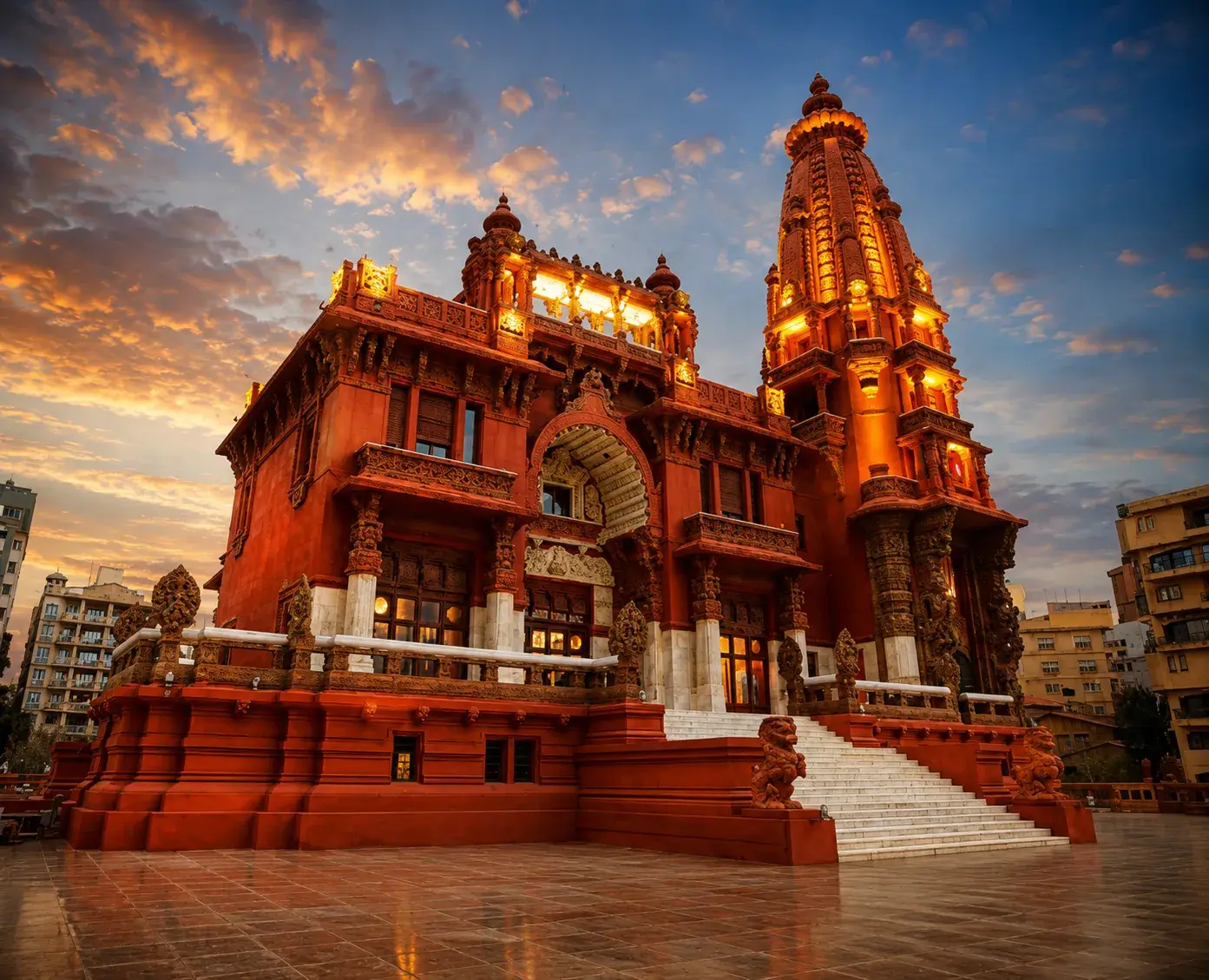
Have you ever imagined wandering through the bustling, cosmopolitan streets of Cairo, only to suddenly stumble upon what looks like an ancient Hindu temple towering above the modern skyline? For decades, tourists have flocked to Egypt seeking the timeless majesty of the Great Pyramids of Giza, the cryptic gaze of the Sphinx, and the gilded treasures of King Tutankhamun. Yet, hidden in plain sight within one of Cairo’s most affluent historical neighborhoods lies a different kind of architectural marvel—a building draped in international history, colonial ambition, and spine-chilling urban legends. If you are looking to step off the conventional tourist trail and dive into a narrative that blends Asian architectural grandeur with Egyptian modern history, then deciding to Visit Baron Empain Palace will be one of the most rewarding choices of your itinerary.
Location of the Baron Empain Palace and How to Get There
The Baron Empain Palace is strategically and prominently located in the heart of Heliopolis (Masr El Gedida), one of Cairo’s most elegant and historically rich districts. Specifically, the palace stands proudly on El Orouba Street, which is the main arterial road connecting downtown Cairo to Cairo International Airport. Its exact location makes it an incredibly convenient stop for travelers who have just arrived in the city or those who have a few hours to spare before catching a departure flight.
Getting to the palace is remarkably straightforward, thanks to Cairo's continuously expanding public transportation network and the abundance of ride-hailing services.
If you prefer to navigate the city like a local and avoid the infamous Cairene traffic jams, the Cairo Metro is your best friend. You can take the modern Green Line (Line 3) and disembark at either the "Kolleyet El Banat" station or the "Al Ahram" station. From either of these stops, the palace is merely a brisk, pleasant ten-minute walk through the leafy, architecturally stunning streets of Heliopolis.
For those who prefer a more direct route, ride-hailing applications like Uber, InDrive, and Careem operate seamlessly throughout Cairo.
Simply enter "Baron Empain Palace" as your destination, and your driver will take you straight to the monumental gates via Salah Salem Road. Alternatively, standard white city taxis are ubiquitous; just ensure the driver turns on the meter or agree on a fare before beginning your journey.
History of Baron Empain Palace
The history of the Baron Empain Palace is inextricably linked to the birth of the surrounding neighborhood, Heliopolis. At the dawn of the 20th century, the area that is now a bustling, tree-lined suburb was nothing more than a vast, unforgiving expanse of arid desert. In 1904, the ambitious Belgian industrialist Baron Edouard Empain arrived in Egypt. While he initially came to save a failing railway contract, he instead fell madly in love with the country's climate, culture, and potential.
Empain was a visionary.
He did not merely want to live in Cairo; he wanted to build his own city. He purchased thousands of acres of desert land to the northeast of Cairo at incredibly low prices and established the Heliopolis Oasis Company. His grand vision was to create a "City of the Sun" (Heliopolis), a luxurious, self-sustaining suburb boasting a unique architectural style that seamlessly blended Moorish, Persian, and European neoclassical influences—a style now famously known as the Heliopolis style.
To crown his new city, the Baron decided to build a grand residence for himself, a palace that would stand out from everything else. Construction began in 1907 and was completed in 1911. For years, the palace was the glittering epicenter of high society in Cairo, hosting lavish parties attended by royals, aristocrats, and international dignitaries.
However, the glory days were tragically numbered. Following the Baron’s death in 1929, the palace remained in the family but slowly began to lose its luster. By the mid-20th century, especially after the 1952 Egyptian Revolution and subsequent nationalizations, the property was abandoned by its foreign heirs. For over half a century, the once-glorious mansion was left to rot. It was stripped of its valuable antiques, its mirrors were smashed, and its gardens became overgrown.
It wasn't until 2005 that the Egyptian Ministry of Housing officially acquired the palace in exchange for land elsewhere in New Cairo. Finally, in 2017, the Egyptian Ministry of Tourism and Antiquities launched a massive, meticulous restoration project. Completed in 2020, this restoration revived the original burnt-sienna color of the exterior and secured the structure, transforming it into a modern heritage exhibition.
Opening Time and Ticket Prices of Baron Palace
Planning ahead is essential to make the most of your decision to Visit Baron Empain Palace. The site operates under the administration of the Egyptian Ministry of Tourism and Antiquities, and it maintains strict visiting hours and tiered ticketing systems.
Operating Hours:
The palace opens its magnificent iron gates to the public every day of the week, including weekends and national holidays.
Daily: 9:00 AM to 5:00 PM.
Tip: The ticket window typically closes at 4:15 PM, so be sure to arrive well before then to guarantee entry.
Ticket Prices:
Egypt operates a multi-tiered pricing system that differentiates between domestic visitors and international tourists. Please note that prices are subject to change, but they generally remain very affordable.
| Visitor Category | General Entry Ticket | Roof Access Ticket (Optional) |
| Foreign Adults | 220 EGP | 120 EGP |
| Foreign Students | 110 EGP | 60 EGP |
| Egyptian/Arab Adults | 60 EGP | 30 EGP |
| Egyptian/Arab Students | 30 EGP | 15 EGP |
Important Note on Photography: Taking photos with your smartphone is completely free and highly encouraged. However, if you plan to use professional DSLR cameras, tripods, or lighting equipment, you will be required to purchase an additional photography permit at the ticket office.
Who Was Baron Edouard Louis Joseph Empain
To truly appreciate the palace, one must understand the eccentric genius behind it. Edouard Louis Joseph Empain was born in 1852 in Belgium. He was not born into nobility; rather, he was a self-made man, a brilliant engineer, and a relentless entrepreneur. He amassed a staggering fortune through international railway projects, most notably constructing the famous Paris Métro. His monumental contributions to European infrastructure earned him the prestigious title of "Baron," bestowed upon him by King Leopold II of Belgium in 1907.
Empain was a man of the world, an avid traveler whose business interests took him to the furthest corners of the globe, including India and Southeast Asia. It was during these travels that he developed a profound fascination with Hindu and Khmer architecture.
When he arrived in Egypt, he found a country that captured his heart unlike any other. He was a man of immense wealth and power, yet he was also an incurable romantic who was deeply moved by the Egyptian desert. The Baron poured his soul and his fortune into the creation of Heliopolis, ensuring it had broad avenues, luxury hotels, golf courses, and an extensive tram network to connect it to central Cairo.
Empain’s dedication to Egypt was so absolute that he drafted a will stipulating he must be buried in the sands of Heliopolis, regardless of where in the world he might pass away. When he died in his native Belgium in 1929 after a battle with a brief illness, his body was repatriated to Egypt. Today, he rests in eternal peace in the crypt of the magnificent Basilica of Notre Dame de Tung, a stunning Catholic church located just a short distance from his beloved palace.
Architecture and Design of Baron Empain Palace
The architectural brilliance of the Baron Empain Palace is arguably its most captivating feature. When designing his dream home, the Baron bypassed traditional European styles and instead commissioned the renowned French architect Alexandre Marcel. Marcel, alongside the gifted interior decorator Georges-Louis Claude, was tasked with bringing the Baron's exotic visions to life.
The primary inspiration for the palace’s exterior was the breathtaking Angkor Wat temple complex in Cambodia, intertwined with distinct elements of classical Hindu temples from Orissa, India. This explains the mesmerizing, almost chaotic abundance of exterior ornamentation. As you approach the building, your eyes are immediately drawn to the intricately carved stone elephants, fierce mythical nagas (serpent deities), serene statues of Lord Shiva and Buddha, and the cascading floral motifs that cover almost every inch of the facade.
Beneath this ornate, ancient-looking exterior lies a triumph of modern 20th-century engineering. The palace was one of the very first buildings in the entire Middle East to be constructed using reinforced concrete, specifically utilizing the pioneering François Hennebique system. This incredibly sturdy construction method is the primary reason the palace survived decades of total abandonment, weathering earthquakes, vandalism, and the harsh Egyptian sun without collapsing.
The building is dominated by a central, multi-tiered tower that spirals upward, catching the eye from miles away. The orientation of the palace was meticulously calculated; the windows and terraces were designed to allow sunlight to penetrate the interior rooms at almost all hours of the day, a nod to the life-giving power of the sun in the "City of the Sun."
Baron Empain Palace Scary Story
No great palace is complete without a great ghost story, and the Baron Empain Palace has generated enough chilling urban legends to fill a library. For decades, the towering, blackened silhouette of the abandoned palace sparked the imaginations of Cairenes, leading it to be dubbed the ultimate "haunted house
The most famous architectural myth surrounding the palace is the legend of the "Revolving Tower." Rumors claimed that the main tower of the palace was built on a mechanical base that rotated a full 360 degrees, allowing the Baron to sit in his study and watch the sun rise and set without ever leaving his chair. While mathematically and mechanically brilliant in theory, modern restorers have confirmed this is purely fiction.
However, the darker tales revolve around the Baron's family. Legend has it that the Baron’s sister, Helena, fell to her death from one of the palace's high balconies. The story goes that the Baron, engrossed in his work in the rotating tower, heard her screams but did not stop the gears in time to save her. Locals claimed that for decades after the palace was abandoned, they could hear the agonizing screams of Helena echoing through the empty halls at midnight.
Another terrifying rumor centers on the "Pink Room" in the basement, where it was said the Baron dabbled in black magic and where the mirrors were allegedly permanently stained with blood. Furthermore, during the late 1990s, the abandoned, pitch-black grounds became a popular secretive hangout spot for teenagers. The loud heavy metal music they played, combined with the flickering candlelight and graffiti, birthed a nationwide panic about underground Satanic cults performing dark rituals in the palace's crypts.
While entirely debunked by historians and the bright lights of the recent restoration, these scary stories remain a beloved part of the palace's modern folklore, adding an irresistible layer of mystery for visitors.
What to See Inside Baron Empain Palace
If you expect to see lavish royal furniture, four-poster beds, and antique dining sets when you walk through the doors, you might be surprised. During the decades of abandonment, the original furnishings were either looted, destroyed, or sold off. Therefore, the Egyptian government made a brilliant pivot during the restoration: instead of faking a historical interior, they transformed the inside into a cutting-edge heritage exhibition.
When you Visit Baron Empain Palace today, the interior is a beautifully curated museum dedicated to the history of Heliopolis and the genius of its founder.
The Heliopolis Exhibition: The ground floor features extensive panels, vintage photographs, and archival blueprints detailing how the desert was transformed into a bustling oasis.
The Grand Spiral Staircase: A stunning, intricately carved wooden staircase remains one of the focal points of the interior, winding elegantly up to the private quarters.
Documentary Screening: Several rooms feature screens playing high-quality documentaries about the Baron's life, the architectural significance of the building, and the painstaking multi-year restoration process.
The Vintage Tram: In the sprawling, perfectly manicured gardens outside, you will find a fully restored, original green Heliopolis tram carriage, a beautiful homage to the transport network the Baron built to connect his city.
What Makes Baron Empain Palace Unique?
What sets the Baron Empain Palace apart from any other historical site in Egypt—and perhaps the world—is its staggering juxtaposition of cultures and eras. It is a monument of profound contradictions.
It is a Hindu and Khmer-inspired temple standing proudly in an Islamic, Middle Eastern capital. It looks like an ancient, stone-carved relic from thousands of years ago, yet it was built just over a century ago using cutting-edge reinforced concrete. It was constructed by a Belgian capitalist who built the Paris Metro, designed by a French architect, yet it became the beating heart of an Egyptian neighborhood. Its uniqueness lies not just in its dramatic aesthetic, but in its survival. It is a phoenix that rose from the ashes of neglect, transforming from a spooky, vandalized eyesore into a gleaming symbol of urban heritage preservation.
Activities You Can Do at Baron Empain Palace
A trip to this historical site offers much more than a simple walk-through. To maximize your experience when you Visit Baron Empain Palace, here are the top activities to include in your itinerary:
Architectural Photography: Whether you are an amateur Instagrammer or a seasoned professional, the exterior of the palace is a photographer's dream. The intricate carvings of serpents and elephants provide endless macro-photography opportunities, while the wide angles of the imposing facade are breathtaking against the blue Cairo sky.
Access the Panoramic Roof: Do not skip buying the extra ticket for roof access. Climbing to the top rewards you with a stunning, unobstructed 360-degree panoramic view of modern Heliopolis, allowing you to see the contrast between the historic palace grounds and the modern, bustling city surrounding it.
Explore the Gardens: The sprawling lawns have been beautifully restored. Take your time walking the perimeter, inspecting the vintage tram, and sitting on the benches to simply absorb the atmosphere of this century-old masterpiece.
Discover El Korba: After your visit, take a short walk or taxi ride to "El Korba," the original commercial heart of Heliopolis. Here, you can admire the original Moorish arches of the buildings the Baron constructed, grab a coffee at a historic café, and reflect on the legacy of the man who built a city in the sun.
Frequently Asked Questions
How much time should I allocate for my visit to the Baron Empain Palace?
A thorough visit usually takes between 1.5 to 2 hours. This gives you ample time to explore the indoor heritage exhibition detailing the history of Heliopolis, walk up the grand spiral staircase, admire the panoramic views from the roof (if you purchased the additional ticket), and take photos around the beautifully landscaped exterior gardens and the vintage tram.
Why is the palace empty of its original furniture and antiques?
Following the Baron's death and the subsequent departure of his heirs mid-century, the palace sat completely abandoned for over 50 years. During this long period of neglect, the original lavish furnishings, chandeliers, and antiques were either looted, destroyed, or sold. Instead of installing fake replica furniture during the 2020 restoration, the Ministry of Tourism and Antiquities cleverly repurposed the empty rooms into a modern, informative museum about the architectural and social history of the Heliopolis suburb.
Is there a strict dress code for visiting the palace?
Unlike active mosques or religious sites in Cairo, there is no strict, mandatory dress code for the Baron Empain Palace as it is a secular historical monument. However, general modest dressing is always recommended when traveling anywhere in Egypt to respect local cultural norms. Comfortable walking shoes are highly advised, as you will be exploring multiple floors, stairs, and the surrounding outdoor gardens.
Conclusion
In a city globally renowned for its ancient pharaonic tombs, towering pyramids, and grand Islamic mosques, the Baron Empain Palace stands as a glorious, eccentric anomaly. It is a physical manifestation of cross-cultural dreams and architectural rebellion. Choosing to Visit Baron Empain Palace is not simply about ticking another site off your Cairo itinerary; it is about stepping into a chapter of modern Egyptian history that reads like a fantasy novel.
From its pioneering reinforced concrete bones and intricate Hindu-inspired carvings to its myth-laden corridors and triumphant multi-million-dollar restoration, the palace offers an unforgettable escape into the mind of a brilliant visionary. Whether you are an architecture enthusiast, a history buff, or a traveler chasing the world's most unique landmarks, this Cambodian-inspired masterpiece in the heart of Heliopolis promises an experience that will linger in your memory long after you have left the bustling streets of Egypt.