
Travel Guide
Ibn Tulun Mosque: Cairo’s Masterpiece of Early Islamic Architecture
9 min read
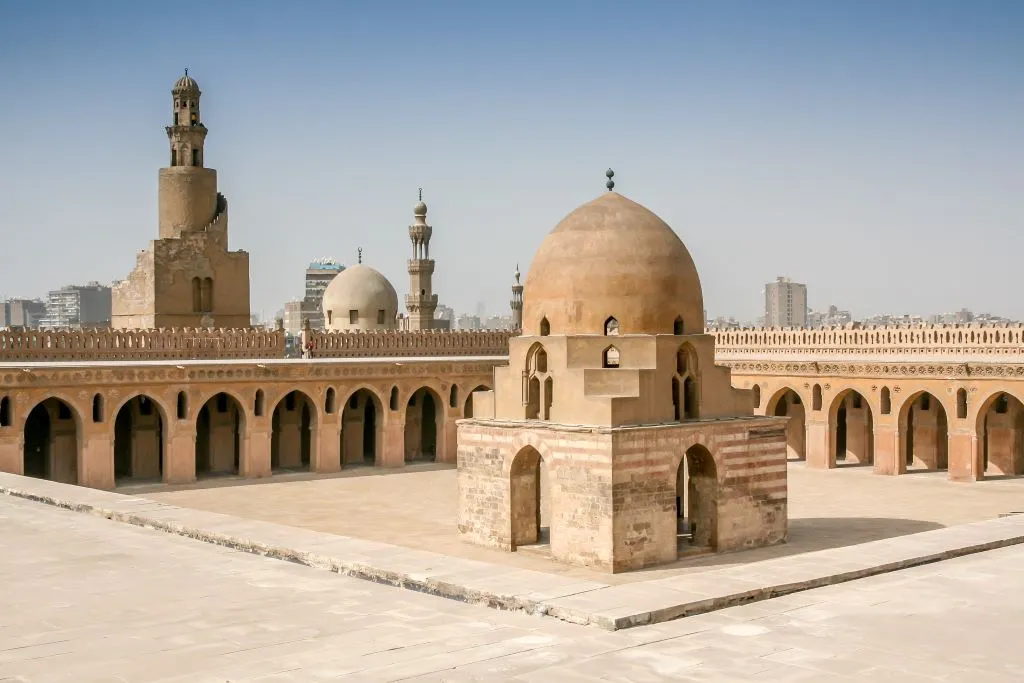
The Ibn Tulun Mosque in Cairo stands as an awe-inspiring symbol of Egypt’s rich Islamic history and architectural innovation. It is the oldest surviving mosque in Cairo, renowned for its vast size, striking red brickwork, and the unique spiral minaret that dominates the skyline. As a living monument to the creativity and strength of the Tulunid dynasty, this mosque enchants visitors with its timeless grandeur and cultural significance stretching over a millennium.
While many monuments in Cairo are celebrated for their intricate Mamluk ornamentation or towering Ottoman minarets, the Mosque of Ahmad ibn Tulun offers an entirely different atmosphere—one characterized by minimalist majesty, spatial purity, and structural resilience.
Location: Nestled on Jabal Yashkur in Cairo
The mosque is prominently located on Jabal Yashkur (The Hill of Thanksgiving), an elevated site in the historic part of Cairo. This strategic placement not only gave it prominence in the city’s ancient landscape but also symbolizes gratitude and spiritual significance. Situated near the Sayyida Zaynab district, the mosque remains a centerpiece in the vibrant modern city yet transports visitors into the depths of time and tradition.
The Mythological and Historical Value of the Hill of Thanksgiving
Jabal Yashkur is steeped in local folklore, long predating the arrival of Islam in Egypt. According to medieval Cairene traditions and local accounts, this elevated limestone outcropping was believed by some to be the sacred destination where Noah's Ark finally came to rest after the cataclysmic global flood.
Strategic Positioning within the Medieval Urban Framework
During the late 9th century, Cairo as we know it today did not exist. Instead, the area was a succession of early Islamic administrative capitals. The strategic location of the mosque on Jabal Yashkur positioned it as an architectural bridge between the older capital of Fustat and the burgeoning imperial complex built by the Tulunid court.
History: Constructed under Ahmad ibn Tulun’s Vision
Commissioned by Ahmad ibn Tulun, the Abbasid governor who gained de facto independence over Egypt between 868 and 884 AD, the mosque was built between 876 and 879 AD. Ahmad ibn Tulun established his own capital, al-Qata’i, and this mosque served as its congregational heart. Despite the destruction of al-Qata’i in the 10th century by Abbasid forces, the mosque survived, making it the sole witness to the Tulunid capital’s legacy and a proud emblem of early Islamic Cairo.
Who Was Ahmad ibn Tulun? A Legacy of Ambition
Born in Samarra, Iraq, in 835 AD, Ahmad ibn Tulun was a Turkish military officer who rose through the ranks of the Abbasid military system.
The Rise of the Tulunid Dynasty and the Birth of Al-Qata'i
Born in Samarra, Iraq, in 835 AD, Ahmad ibn Tulun was a Turkish military officer who rose through the ranks of the Abbasid military system.
The Rise of the Tulunid Dynasty and the Birth of Al-Qata'i
To cement his imperial sovereignty, Ibn Tulun constructed a brand-new palace city named al-Qata’i (meaning "The Quarters").
Architectural Design
The mosque’s vast hypostyle courtyard spans over 6 acres, surrounded by arcades with red brick piers supporting the roof. Its design was inspired by the Great Mosque of Samarra in Iraq, especially the distinctive external spiral minaret, one of only a few in the world. The building features ‘arais’—crenellations shaped like abstract human or doll forms—which embellish the façade. The extensive use of fired red brick, carved stucco decorations, pointed arches, and detailed motifs distinguishes Ibn Tulun as a masterpiece of Islamic architecture with an innovative spirit.
What Makes Ibn Tulun Mosque Unique?
Its remarkable survival through centuries of urban change, wars, and reconstructions makes it extraordinary. The Ibn Tulun Mosque is one of the few remaining examples of early Abbasid architecture in Egypt, notable for its scale and originality. The spiral minaret, the large open courtyard, and its intricate decorations combine to create an architectural harmony rare in the region. As the oldest mosque in Cairo still in use, it remains a living testimony to Islamic spiritual and artistic heritage.
Unlike most of the historic mosques located along the nearby Al-Muizz Street or within the Khan El Khalili district, which were continuously rebuilt, layered, and heavily modified during the height of the Mamluk and Ottoman eras, Ibn Tulun retains its foundational 9th-century structural integrity.
Fascinating Facts About Ibn Tulun Mosque
The External Spiral Minaret: The spiral minaret is inspired by the Great Mosque of Samarra but is unique for being external. It features an exterior staircase winding up to the tower, allowing brave travelers to ascend for panoramic views of old Cairo.
The Christian Architect al-Nasrani: It was designed by al-Nasrani, a highly skilled native Christian architect, reflecting profound cultural collaboration and interfaith engineering cooperation in early medieval Egypt.
Fire-Resistant Red Brick Construction: The mosque’s red brick construction is highly unusual for Cairo, where stone was more common. This design choice was intentionally selected to ensure the building would survive fires or devastating floods.
Surviving Total Urban Erasure: It survived the absolute destruction of the Tulunid capital city (al-Qata'i) and withstood various major earthquakes that damaged other stone structures over the centuries.
Global Influence on Architecture: Its revolutionary architectural elements—such as the systematic use of brick piers and pointed arches directly influenced later Islamic and Western European Gothic constructions.
The Massive Quranic Frieze: Running along the top of the interior arcades are original sycamore wood panels inscribed with verses from the Holy Quran in beautiful Kufic script.
Best Times to Visit for Photography and Serenity
To experience the true spiritual essence and architectural beauty of the site, consider arriving during the early morning hours (between 8:30 AM and 10:30 AM). During this window, the morning sun hits the upper registers of the eastern arcades, casting long, sharp geometric shadows through the 128 pierced stucco windows across the floors.
Alternatively, a late afternoon visit allows you to watch the sunset from the top of the spiral minaret, where you can listen to the evening call to prayer (Adhan) echo simultaneously from hundreds of minarets across the Cairo skyline.
Frequently Asked Questions
- When was Ibn Tulun Mosque built?
The mosque was constructed during the Tulunid dynasty, specifically between the years 876 and 879 AD, making it the oldest surviving mosque in Cairo that has largely retained its original architectural form.
- Who designed Ibn Tulun Mosque?
Historical records indicate that the mosque was designed by an Egyptian Christian architect named al-Nasrani, highlighting an early instance of interfaith artistic and engineering collaboration.
- Is entry to the mosque free for tourists?
Yes, entry into the central prayer spaces and courtyards is generally free, though visitors are highly encouraged to offer a modest tip to the local shoe attendants at the entrance doors.
Conclusion
The Ibn Tulun Mosque is much more than a historical building; it is a living symbol of innovation, resilience, and spiritual devotion. Visiting this iconic site offers travelers the chance to walk through a millennium of history and experience the grandeur of one of Cairo’s most remarkable landmarks. It stands as a bridge connecting past and present, faith and art, making it an unforgettable destination for all.
Whether you are an architectural enthusiast tracing the roots of the systematic pointed arch, a photographer seeking the play of light through ancient stucco screens, or a curious traveler eager to see the panoramic layout of Cairo from a helical tower, Ibn Tulun provides an authentic experience.