
Travel Guide
Unveiling the Mystique of Kom Ombo Temple: The Ultimate Visitor's Guide
9 min read
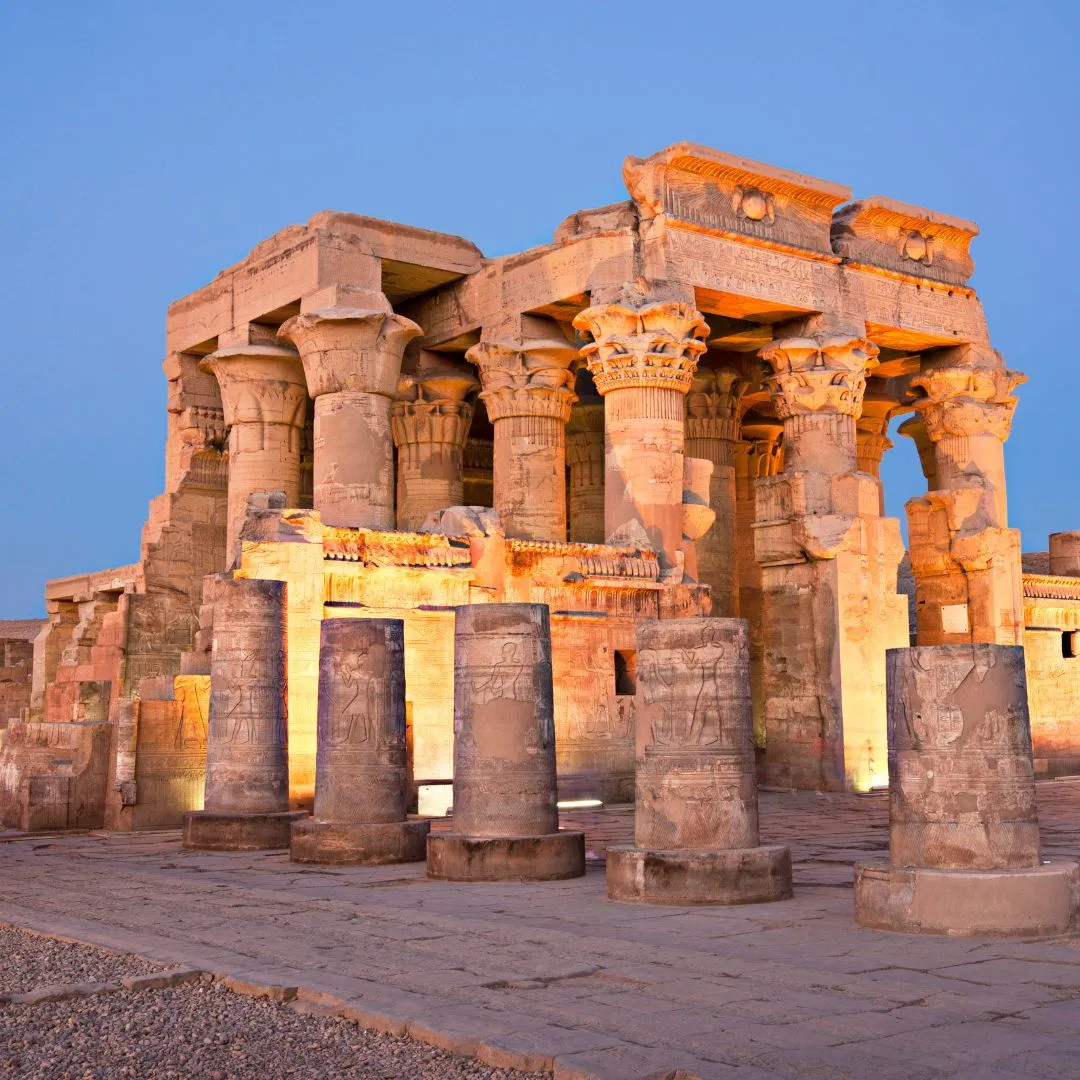
Kom Ombo Temple is a uniquely symmetrical, double-dedicated ancient Egyptian sanctuary constructed during the Ptolemaic dynasty (180–145 BCE). Perched dramatically on a scenic cliff overlooking a strategic bend of the Nile River in Upper Egypt, it stands as the only historical monument completely divided down the center to honor two competing deities simultaneously: Sobek, the crocodile god of fertility, and Horus the Elder, the falcon-headed god of light and protection.
While Egypt is home to hundreds of remarkable Pharaonic structures, this specific cliffside monument offers an unparalleled architectural anomaly. Historically, the deep waters around this particular bend of the Nile were heavily infested with wild crocodiles, leading ancient Egyptians to establish a cult center here to appease these ferocious predators.
Today, this magnificent Greco-Roman temple serves as a mandatory stop for nearly 85% of international travelers embarking on luxury Nile Cruises between Luxor and Aswan. Beyond its striking dual architecture, the complex houses world-renowned medical reliefs showcasing advanced ancient surgical instruments, a perfectly preserved Nilometer, and an adjacent, state-of-the-art Crocodile Museum displaying dozens of mummified ancient reptiles.
In this definitive guide, we will explore the fascinating history, sacred architecture, hidden engineering marvels, and essential visitor logistics you need to experience the full magic of the temple.
History of Construction: The Greco-Roman Masterpiece
The construction of the Kom Ombo Temple as it stands today primarily began during the Ptolemaic period under the reign of King Ptolemy VI Philometor (180–145 BCE). However, archaeological excavations reveal that the foundations were laid upon much older, ruined sacred structures dating back to the New Kingdom era, specifically under Thutmose III and Hatshepsut.
The development and ornate decoration of the temple was a massive, multi-generational undertaking that lasted for nearly 400 years, extending well into the Roman era. Subsequent Ptolemaic kings, most notably Ptolemy XII Auletes (the father of the famous Cleopatra VII), expanded the majestic hypostyle halls. Later, Roman emperors such as Augustus, Tiberius, and Domitian added their own cartouches, intricate reliefs, and external defensive walls. This extensive timeline created a breathtaking architectural hybrid, seamlessly blending ancient Egyptian religious iconography with Hellenistic and Greco-Roman artistic styles.
Location and Meaning of Kom Ombo
The Kom Ombo Temple is strategically situated on the east bank of the Nile River, approximately 45 kilometers (28 miles) north of Aswan and 137 kilometers south of Luxor. This precise geographic location was of immense economic and military significance in antiquity.
The name "Kom Ombo" beautifully reflects its physical and economic heritage:
"Kom" is the Arabic word for "mound" or "hill."
"Ombo" is derived from the ancient Egyptian word "Noubt", which translates directly to "Gold."
Therefore, Kom Ombo literally translates to "The Golden Mound." In ancient times, this elevated hill served as a vital trading post and defensive gateway controlling the lucrative gold trade routes running between the eastern deserts, Egypt, and Nubia. Its high elevation also protected the sacred precinct from the unpredictable and destructive annual flooding of the Nile.
Why Was the Temple Built? The Sacred Duality of Sobek and Horus
What truly isolates the Kom Ombo Temple from every other religious monument in the world is its radical layout built on absolute duality. It was intentionally designed to balance two separate, contrasting theological systems: chaos and order.
The right-hand (southern) side of the temple was dedicated entirely to Sobek, the crocodile deity associated with water, fertility, and the untamed, chaotic forces of nature. The left-hand (northern) side was dedicated to Horus the Elder (Haroeris), the sky god, supreme doctor, and falcon-headed protector representing cosmic order, divine kingship, and civilization.
To avoid insulting either powerful deity or their passionate local cults, the Ptolemaic architects designed a perfectly mirrored master plan. The temple features a double set of entrances, parallel processional axes, matching hypostyle halls, and twin sanctuaries at its dark core, ensuring both gods received equal devotion and architectural symmetry.
Inside the Architectural Layout: Parallel Sanctuaries
Navigating the interior of the Kom Ombo Temple feels like walking through two identical temples fused side-by-side. Visitors enter through a massive, shared outer pylon that opens up into a grand forecourt surrounded by sixteen monumental columns, beautifully adorned with reliefs depicting Ptolemaic pharaohs making sacred offerings to the dual gods.
As you advance along the parallel axes, you pass through the Outer Hypostyle Hall and the Inner Hypostyle Hall. The soaring columns within these chambers are famous for their varied, exquisite "composite capitals," which merge traditional Egyptian lotus and papyrus flora motifs with Hellenistic artistic flair. The journey culminates in the twin inner sanctuaries (Holy of Holies), where the stone pedestals that once held the sacred wooden barques (boats) of Sobek and Horus still stand in silence.
The Famous Surgical Instruments Relief
Located on the back wall of the temple’s outer corridor is one of the most significant and heavily studied reliefs in medical history. This extraordinary carving depicts what historians widely believe to be the first recorded collection of advanced surgical instruments in human history.
The relief shows a seated god Horus overseeing a medical scene, flanked by a comprehensive medical kit. Carved into the limestone walls with meticulous detail, visitors can clearly identify:
Scalpels, bone saws, and dental forceps.
Surgical scissors, needles, and specialized probes.
Sponge-like materials, medicine scales, and birthing chairs used for deliveries.
This incredible wall carving provides undeniable proof that the priests of Kom Ombo practiced advanced medicine and treated complex pathologies, acting as a massive medical sanctuary for the local population.
The Ancient Nilometer
Located within the northern perimeter of the temple complex is a masterfully engineered Nilometer—a deep, circular stone well connected directly to the Nile River via underground conduits.
In ancient Egypt, the Nilometer was a critical administrative and financial tool. Temple priests would descend the spiral stone staircase inside the well to measure the exact height of the Nile’s water during the annual flood season. If the water level was high, it predicted a bountiful harvest, allowing the government to calculate agricultural taxes for the year. If the water was too low, it signaled impending drought and famine, prompting the priests to implement food rationing programs.
The Crocodile Museum: A Unique Companion Experience
Located just a few steps away from the temple’s main exit gate sits The Crocodile Museum, a state-of-the-art exhibition hall that is automatically included in your main temple admission ticket. This highly specialized museum provides essential context to the temple's ancient animal cults.
The museum features a beautifully lit collection of over 20 mummified crocodiles of various sizes, ranging from massive, full-grown adult reptiles to fragile, freshly hatched babies and even unhatched fossilized crocodile eggs. These mummies were discovered in a nearby ancient animal cemetery known as El-Shatb. The exhibition also displays intricate ancient stelae, wooden crocodile coffins, and golden eyes that were placed inside the mummified remains, showcasing the deep, reverential awe the ancient Egyptians felt for Sobek.
How to Visit Kom Ombo Temple: Nile Cruises and Logistics
The overwhelming majority of travelers visit Kom Ombo Temple as a premier shore excursion during a 3-night or 4-night Nile Cruise sailing between Aswan and Luxor. Because the temple is located directly on the riverbanks, cruise ships tie up right in front of the monument, allowing guests to walk straight from their floating hotels directly to the temple gates in less than two minutes.
For independent travelers, the temple can easily be reached via a 1-hour private car ride or taxi transfer from Aswan, or a 2.5-hour drive south from Luxor. It can also be combined with a visit to the nearby Temple of Horus at Edfu for a spectacular day trip.
Tickets, Opening Hours, and Magical Night Visits
Unlike many other ancient monuments in Egypt that close at sunset, Kom Ombo remains open late into the evening. Visiting the temple at night is highly recommended; the entire limestone complex is illuminated by an artistic, warm lighting system that accentuates the deep relief carvings and casts a magical glow over the dark waters of the Nile.
| Travel Logistics | Current Details |
| Operating Hours | 6:00 AM – 9:00 PM (Daily) |
| Best Time to Visit | 4:30 PM – 7:00 PM (To catch the sunset over the Nile and the night lights) |
| Adult Ticket (Foreigners) | 450 EGP (Includes entry to the Crocodile Museum) |
| Student Ticket (Foreigners) | 225 EGP (Requires a valid international student ID card) |
Frequently Asked Questions
Why is Kom Ombo Temple dedicated to two gods?
The temple was dedicated to both Sobek (the crocodile god) and Horus the Elder (the falcon god) to harmonize the local population. The area was dangerous due to wild Nile crocodiles, so building a dual temple appeased the destructive forces of Sobek while invoking the healing and protective powers of Horus.
Where is Kom Ombo Temple located?
The temple is located in Upper Egypt, beautifully positioned right on the east bank of the Nile River. It sits roughly 45 kilometers north of Aswan and about 137 kilometers south of Luxor, making it a key stop for river cruises.
What is the most unique thing to see inside Kom Ombo Temple?
The most famous highlight is the medical and surgical instruments relief carving, which displays the world's earliest known medical tools. Additionally, the twin, perfectly symmetrical sanctuaries and the adjacent Crocodile Museum are completely unique to this site.
Conclusion
The Kom Ombo Temple stands as a profound testament to the spiritual depth, artistic adaptability, and scientific brilliance of late-era ancient Egypt. It is much more than a collection of weathered stone ruins; it is a living monument where religion, advanced medicine, and civil engineering collided. From its perfectly balanced double sanctuaries to the hauntingly beautiful mummies inside the Crocodile Museum, this cliffside sanctuary offers an immersive historical journey that cannot be replicated anywhere else on earth. Whether you arrive via a traditional Nile Cruise or an independent day trip, watching the sunset over the Nile from these ancient walls is an absolute highlight of any Egyptian vacation.